

Bayesian Network Representation
D-separation
A method to determine if two nodes are conditionally independent given a set of other nodes in a directed graph.
The goal is to understand when can we guarantee that an independence
Types of connections between X and Y
Direct connection: if
Indirect connection between
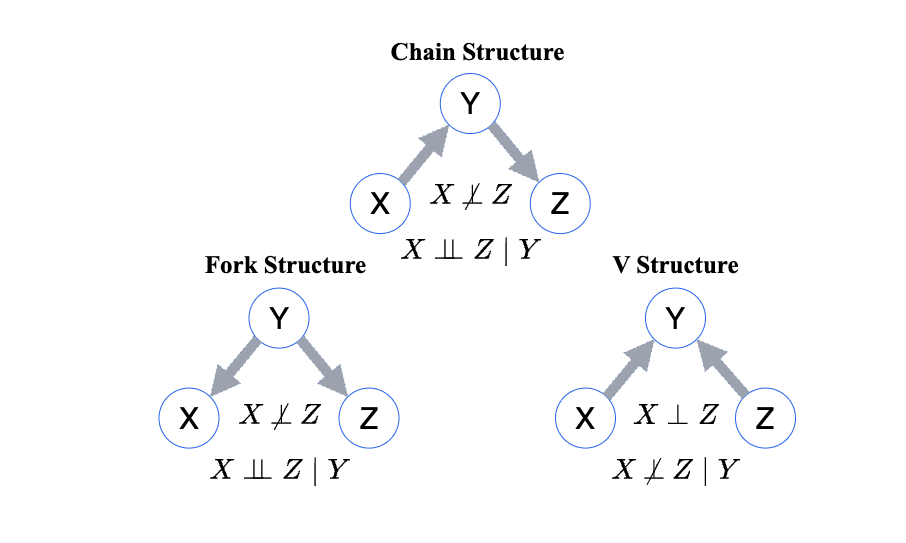
Indirect Causal Effect
- A. If G is observed, I and L are independent (
). - B. If G is not observed, I influences L through G.
- Causal trail
is active if (if and only if) Z is NOT observed;
Indirect Evidential Effect
- A. Observing L affects beliefs about I.
- B. Observing G blocks the effect of L on I.
- Evidential trail
is active iff Z is NOT observed;
Common Cause
- A. G and S are correlated if I is not observed.
- B. Observing I blocks the path between G and S.
- Common cause
is active iff Z is NOT observed;
Common Effect
- A. I and D are independent if G is not observed.
- B. Observing G (hard evidence) makes I and D correlated.
- C. Observing a descendant of G (like L) also makes I and D correlated.
- D. Explaining away occurs: observing G or its descendant affects beliefs in both I and D.
- Common effect
is active iff either Z or Z’s descendant is observed.
General Cases:
A longer trail
a.
ii. If
iii. If
iv. If
A simpler definition: Two nodes
Intuition: If nodes
Definition: Let
We use
it is called the set of global Markov independencies.
D-separation is a condition/algorithm for answering the queries, a criterion that helps to decide given a graph, whether one set of variable is independent of another set of variables, given a third set.