Entity-Relationship-Model-Modeling
- Design Process
- Entity Sets
- Attributes
- Relationship Sets
Database Design Process
The goal of the relational database design is to create a database in a specific database management system that allows us to
- Store information
- Minimize unnecessary redundancies
- Search information easily
Design database can be split into multiple phases.

Conceptual design
- Focus on describing data and their relationships.
- The outcome of this phase is an ER diagram.
- It provides a graphic representation of the database design.
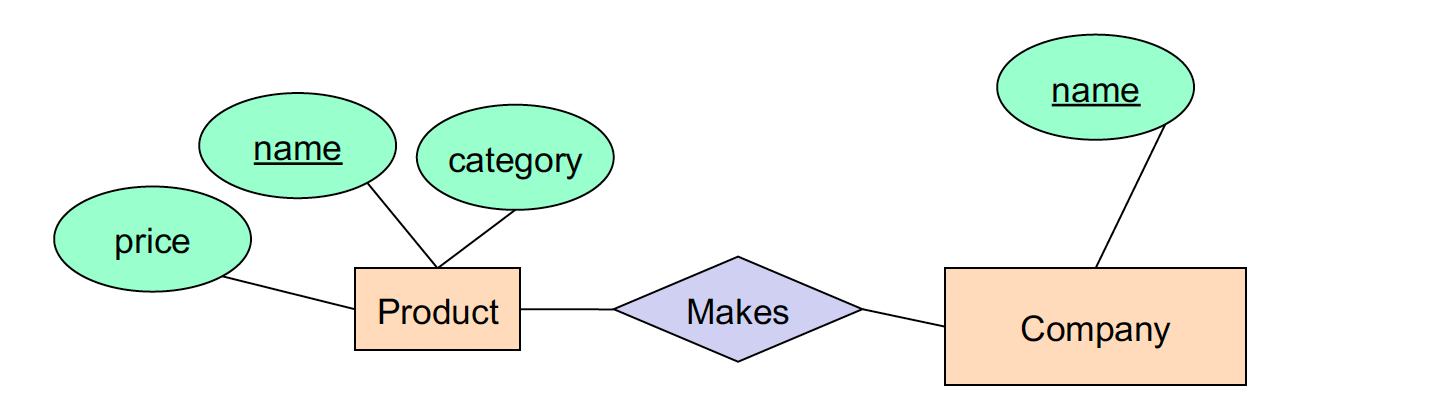
However, designing an ER diagram can be very subjective. Then, the next phase is optimizing the ER diagram using functional dependencies and normal forms.
Optimization
- Optimizing the ER diagram using functional dependencies and normal forms.
Convert ER diagram to implementation data model
This phase is to convert an ER diagram to the implementation data model of the database system that will be used.
Logical design
- Relational schemas will be produced. The relational schemas of a database are called logical view.
Physical design
- Designers will implement the relational schemas in the database management system using a particular data definition language.
Entity Set
- The entity-relationship model contains three basic concepts:
- entity sets
- relationship sets
- attributes
An entity is a “thing” or “object” in the real world, which is distinguishable from all other objects. An entity set is the class or type of objects in our model.
Attribute
- An entity can be described by a set of properties.
- Each property is an attribute of the entity.
- A set of attributes describes and distinguishes the entities in the same entity set.
- One entity can have different attributes in different models for different applications.
- Each entity has a value for each of its attributes.
- The Domain of an attribute is the set of all possible values of the attribute.
ER-Diagram
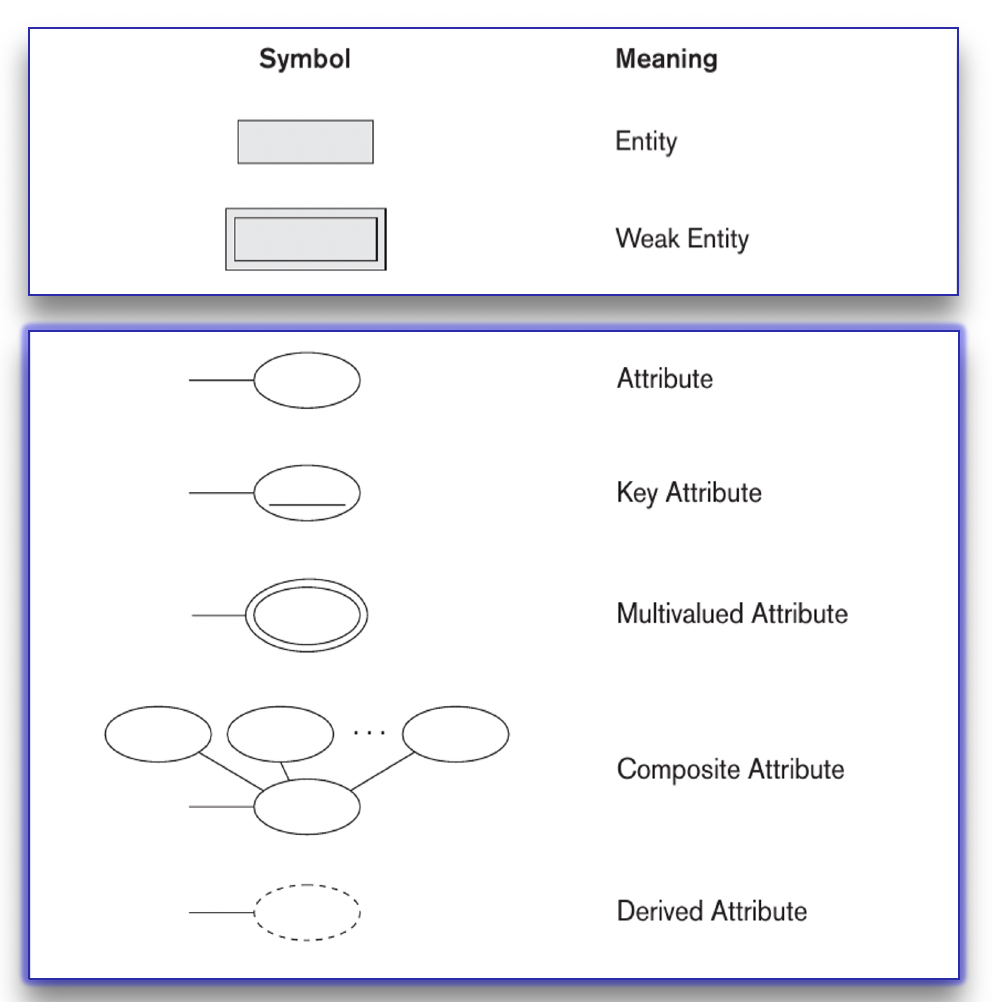
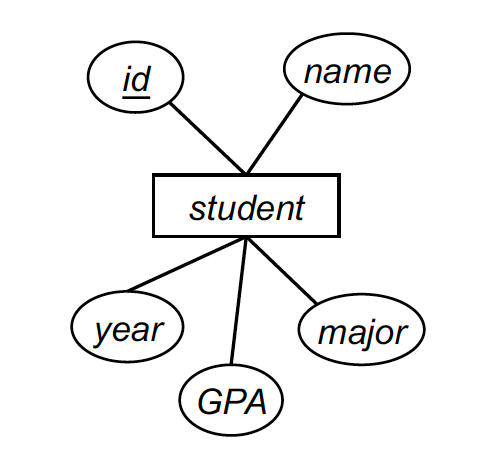
- rectangles represent entity sets
- ellipses represent attributes
- keys are underlined
- lines link attributes to entity sets
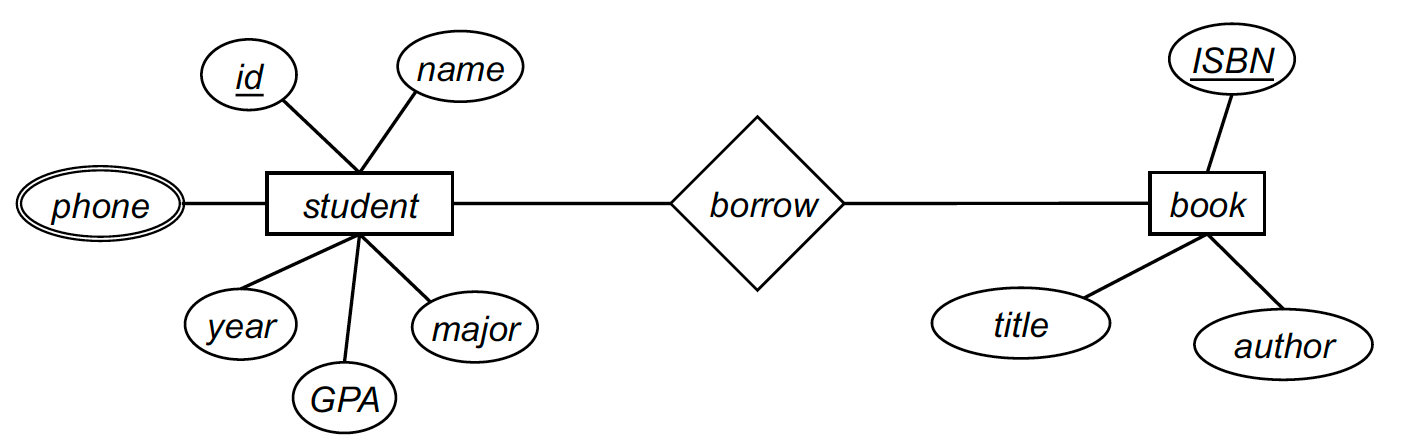
- a relationship set is denoted by a diamond
Key
- The set of special attribute(s) is called key.
- Formally, a key of an entity set is a set of attributes that can uniquely identify the entities.
- Two entities are identical if and only if they have the same value for the key.
Multi-valued Attribute
- An entity may have multiple values in an attribute which is multi-valued attribute, denoted by double ellipses.
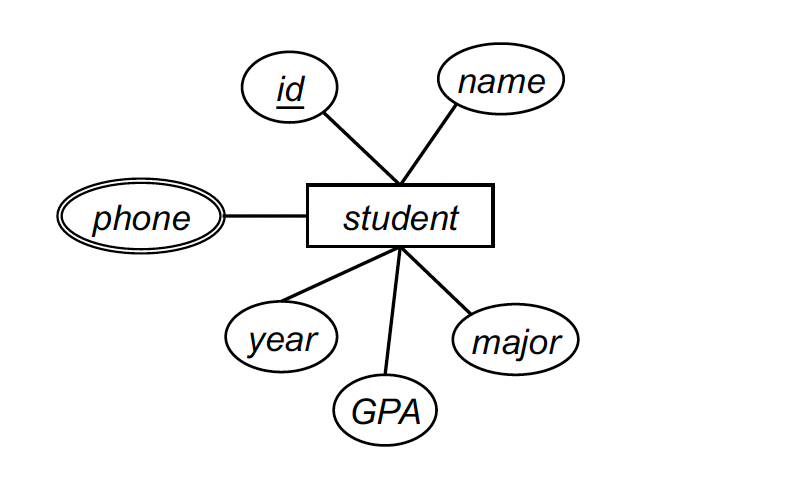 It is possible that one student may have multiple phone numbers.
Composite Attribute
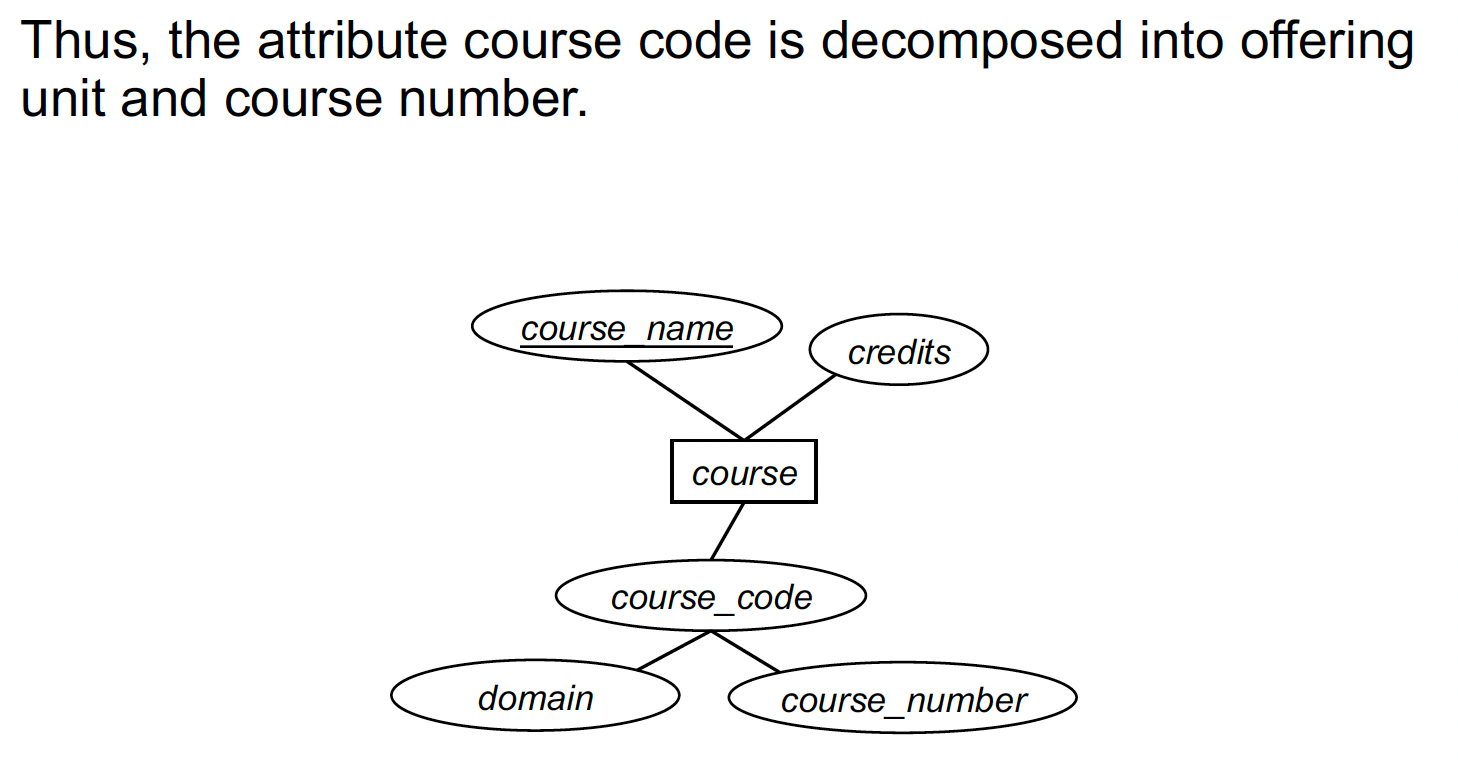
- One may ask “why the course code is not selected as a key?”
- The reason is that a course code is not atomic.
- An attribute is atomic if each value of the attribute has only one unit of information.
- If an attribute is not atomic, it is a composite attribute.

Relationship
- A relationship set is a set of relationships of the same type.
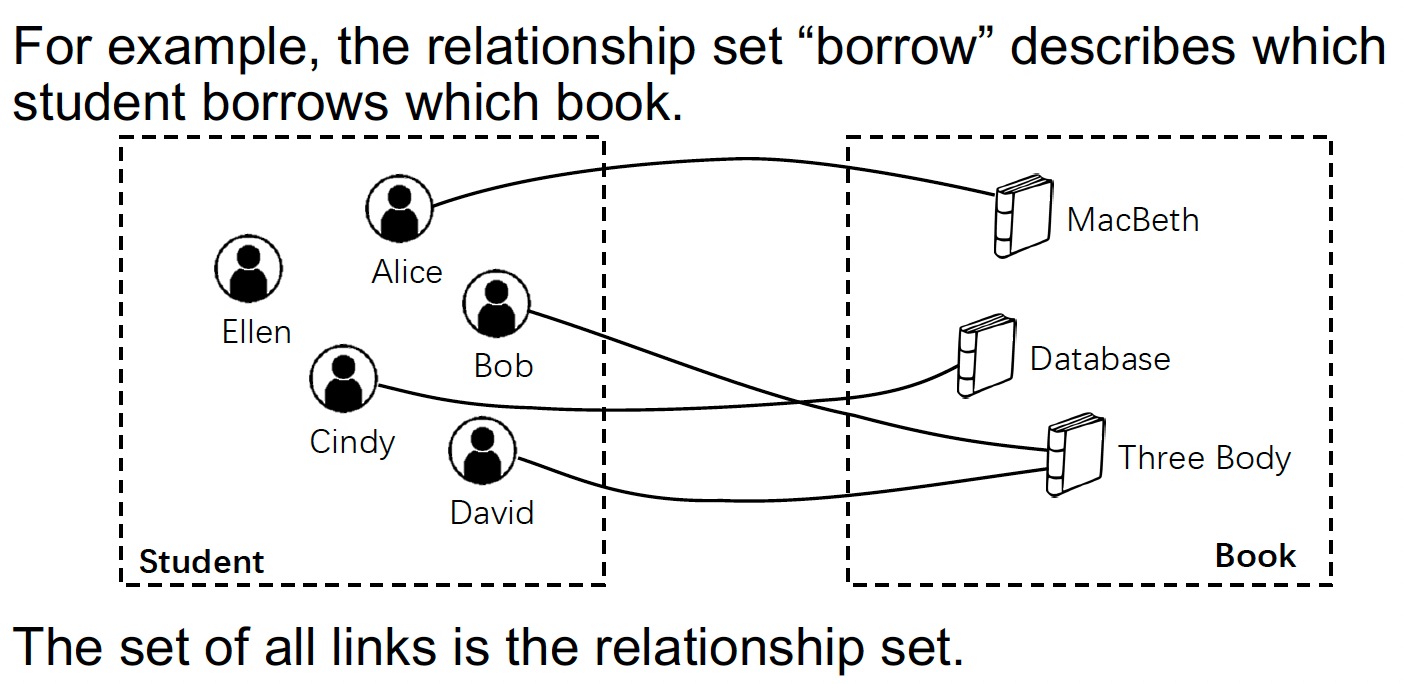
- Sets do not allow duplications.
- This is also applied to entity sets.
Multi-ary Relationship
- If a relationship associates 𝑛 entities, this relationship is 𝒏-ary.
- 𝑛 is the degree of the relationship
- If 𝑛 = 2, the relationship is binary.
- If 𝑛 = 3, the relationship is ternary.
- Theoretically, 𝑛 can be any positive integer.
Attributes for Relationship Sets
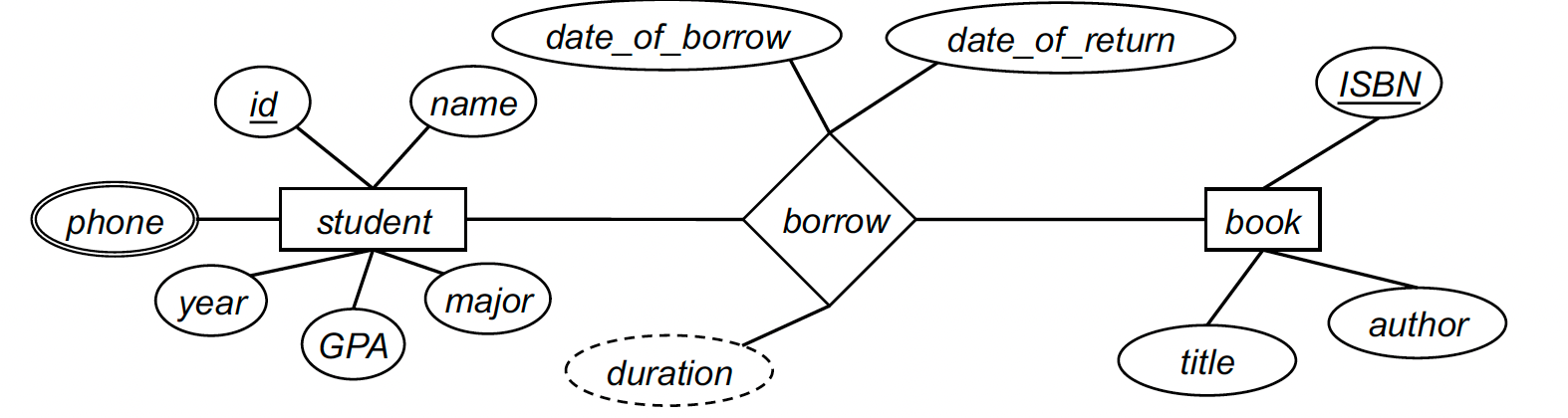
- The relationship set can also have some attributes.
- Example:
- Sometimes people are also interested in some information about relationships.
- In the “students borrow books” example, we also want to know when the book is borrowed, when the book is returned, and how long the book is kept by the student.
- This information does not belong to students or books. It is about the association.
Derived Attributes
- In the previous example, the attribute duration is in a dashed ellipse because it is a derived attribute.
- If one knows the date of borrow and the date of return, then the duration can be calculated from the two values.
Summary